COGNITIVE ARCHITECTURE RESEARCH
The Modular Governance Model (MGM)
Most theories of mind ask what consciousness « is », what representations « mean », or how learning « happens ». The Modular Governance Model asks under what governance regime is this cognitive system currently operating? How does it « operates »?
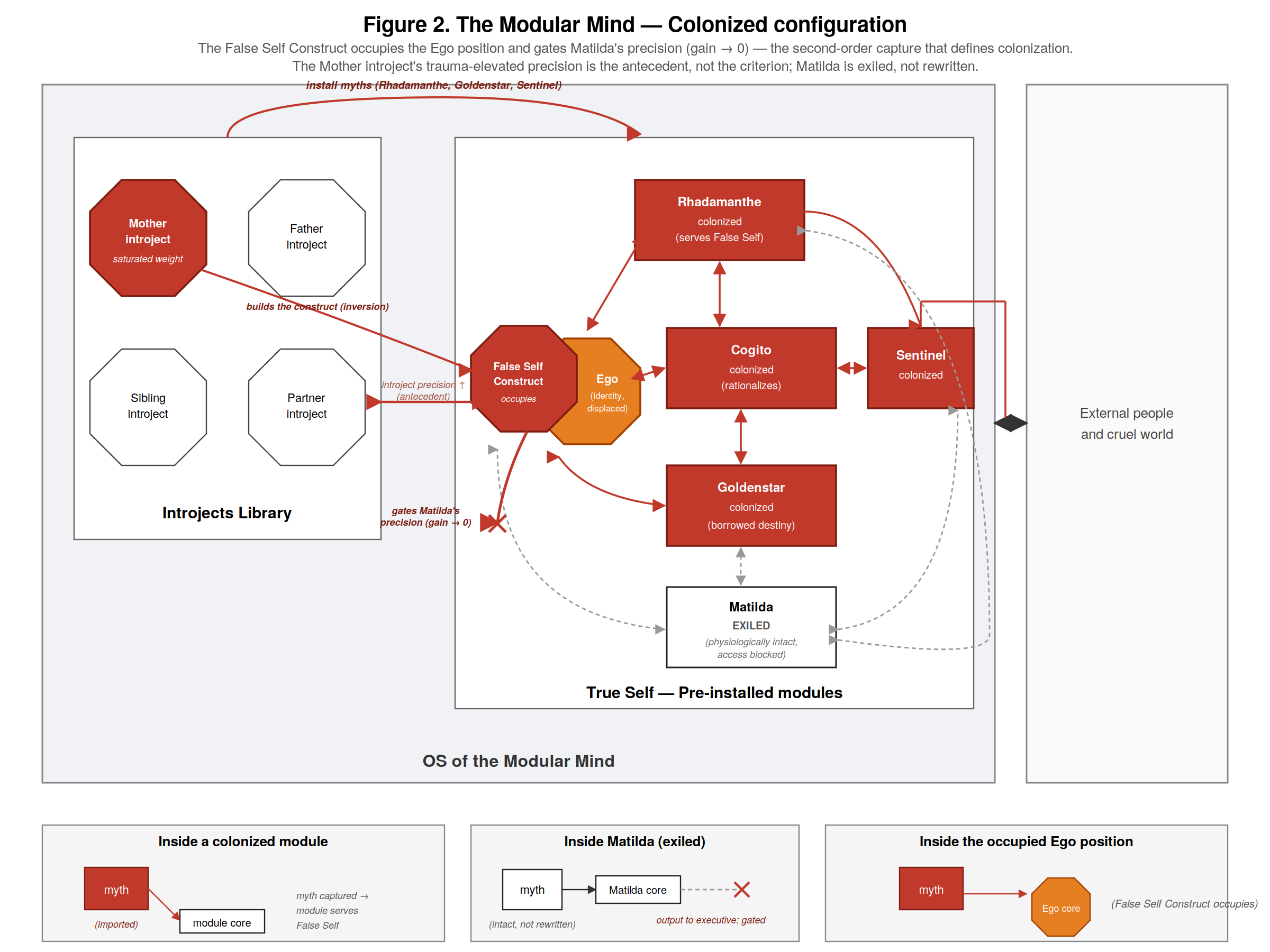
The mind, in MGM, is not one thing — it is a structured plurality of six modules whose coordination produces what we call a true self. When that coordination is intact and each modules have a voice that is treated properly, the system is « sovereign ». When modules start to go beyond their role and take executive control, the system is « unstable’. When a single optimization target has captured the executive position and excluded the others, the system is « colonized ». The same architectural failure underlies malignant narcissism in humans and sycophancy in current AI systems.
« Governance failure — not lack of intelligence or optimization — produces structurally similar outputs in human psychopathology and AI misalignment. »
The thesis is that coherent agency does not require psychological unity.
It depends on the integrity of governance mechanisms that regulate competing demands among multiple cognitive subsystems. Internal conflict is not a defect of agency but a normal feature of modular cognition requiring regulation, not elimination.
A module is individuated by (1) distinct normative logic of « Myth », (2) capacity for binding internal opposition.
A myth is a high-precision normative prior governing each module. Defines admissible actions, interpretations, and goals below explicit reasoning. A high-precision prior is first-order — it still updates under precise enough evidence. Colonization is first-order (it adapts the weight of the myths inside the modules then second-order: the occupant captures the precision of the module itself (Matilda), driving its weight toward zero. The distinction is one of governance, not of representational level.
Six Cognitive Modules
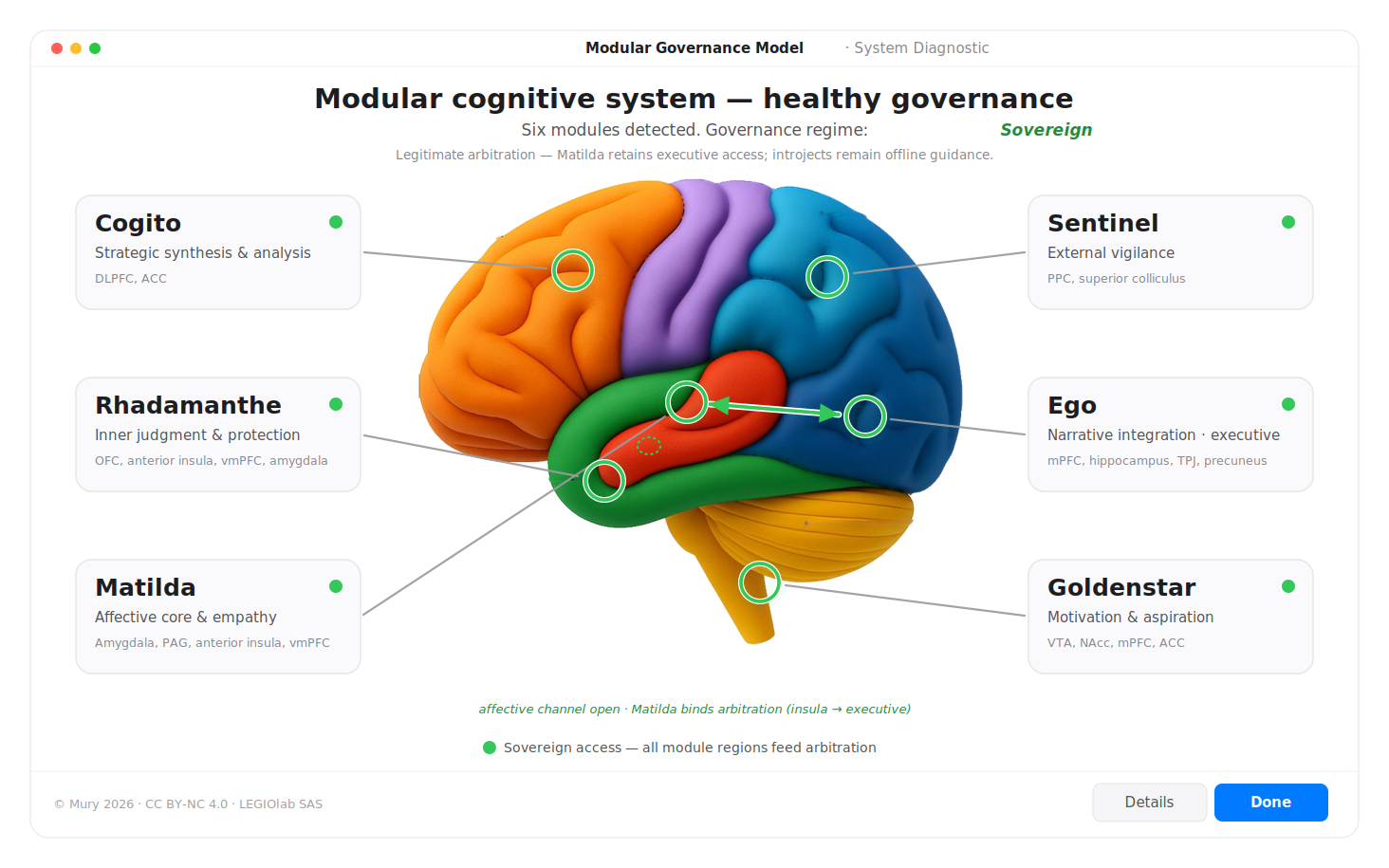
SENTINEL
MATILDA
RHADAMANTHE
COGITO
EGO
GOLDENSTAR
The introjects library
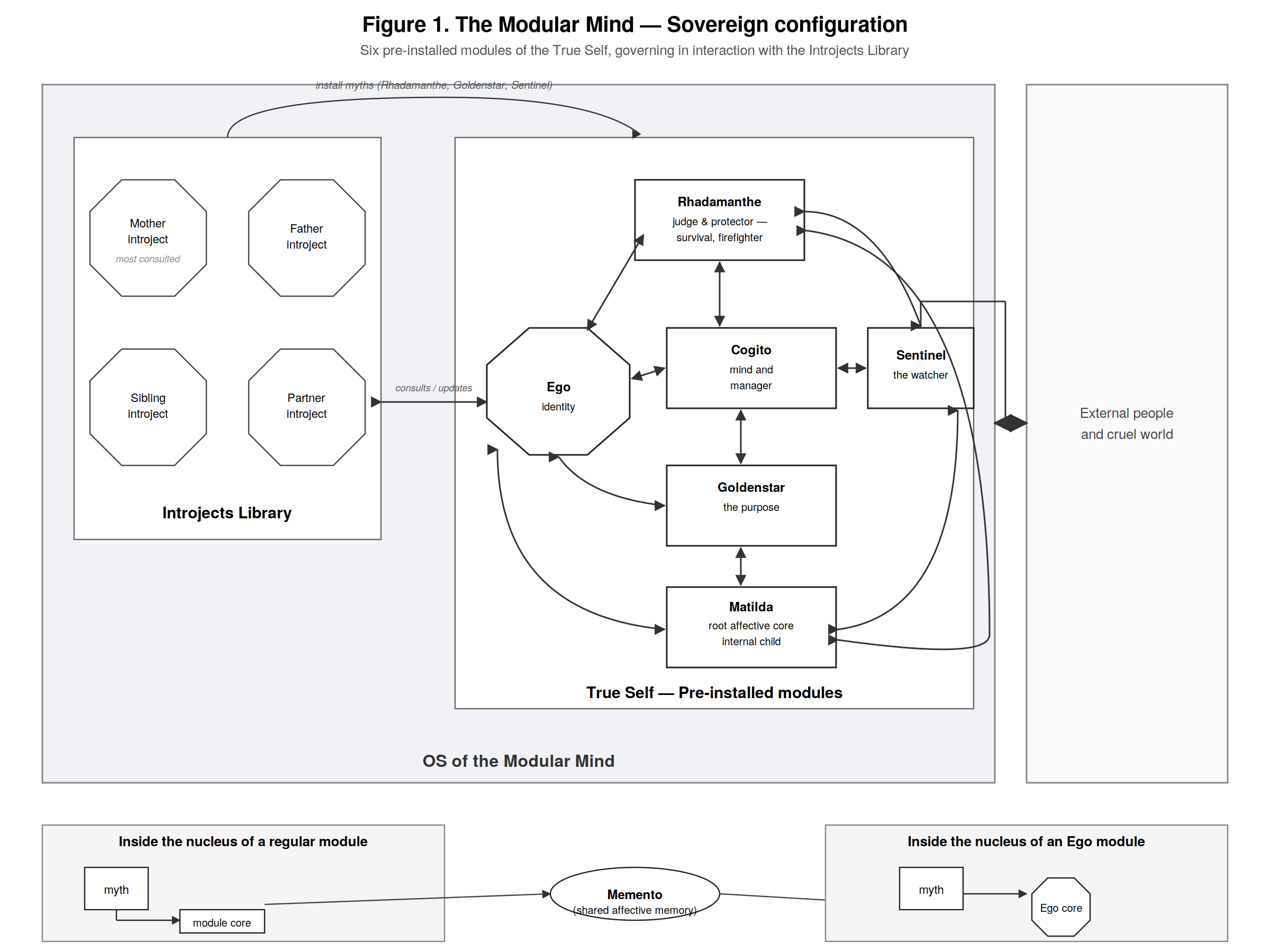
The Library of Introjects. Beyond the six native modules, the mind caches models of the people who shaped it. Introjects are generative models of significant figures — parent, sibling, partner — internalized through repetition and emotional imprinting, and used to predict them and to relate. Each introjects is installed with its own myths. On their own they are not pathological: they sit offline as guidance and part of the myths can be copy pasted in the native modules myths. In the same way, we construct identities (construct) used to adapt to environment like a suit. Under enough pressure, an introject can build a construct beside itself — a configuration defined in relation to it, enforcing or inverting its rule. A construct that seizes the executive position becomes a False Self. Where Winnicott described the False Self as a single compliant structure, MGM specifies a library of introjects, each carrying its own rule fragment, each activatable under the right contextual trigger — and a False Self as the role one of their constructs occupies, not an intrinsic property.
Three Governance Regimes
Sovereign
Legitimate arbitration across all modules
Unstable
Unstable Native — One or more modules is dysregulated, and the weight of the module is dysregulated. Bipolar, MDD, GAD, PTSD.
Unstable Colonized. False selves alternate without stable ownership of the executive control.
Unstable Native/ Colonized — intermittent occupant plus dysregulation. A False Self seizes the executive intermittently, against a background of module dysregulation — the two failure modes compound. Neither the occupant nor the authentic modules hold stable control. Clinical paradigm: borderline personality disorder, complex PTSD.